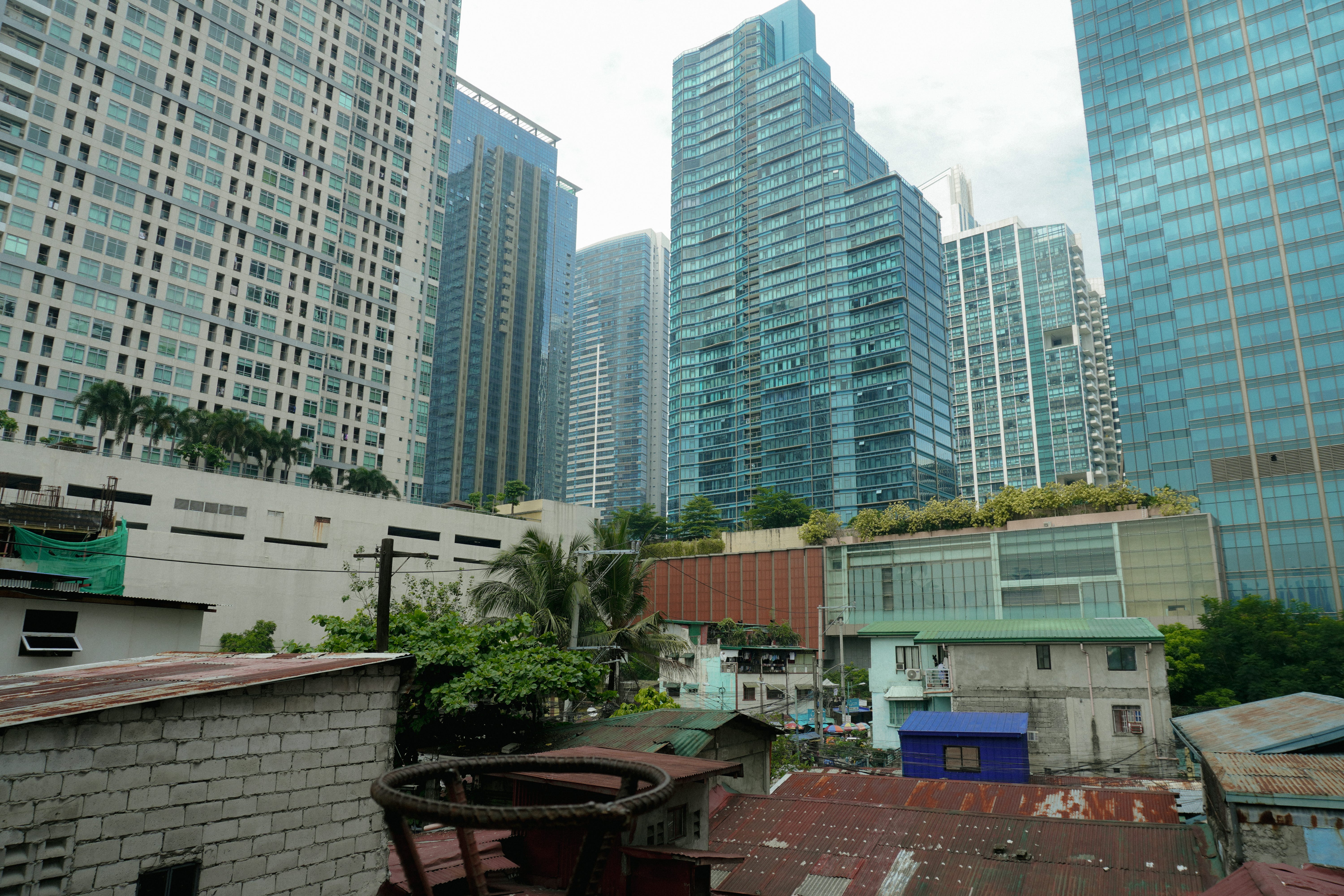
In BGC, there's one skyline but two worlds
Piolo Cudal, Katrina Lazarra, Mikaelah Panopio


When one thinks of Bonifacio Global City (BGC), visions of a luxurious lifestyle encompassing high-end living, dining, and entertainment come to mind. However, stepping through a portal-like passageway reveals a world distinct from BGC's offerings.
Just 20 steps away from the bustling cityscape, eateries, street food vendors, and sari-sari stores line a busy street in an area famously known as BGC Butas. In contrast to the organized and orderly city, a Barangay Official of South Cembo described the area as "untidy" and likened it to Quiapo.
Employees coming from different companies flood the area, especially during their lunch break, to munch on the home-cooked meals from various eateries or have a quick bite on the parked tusok-tusok sidecar.
For regular customers like Melvin Gonzalez, a housekeeping personnel within BGC, the Butas is immensely helpful. Here, food prices are nearly half of what is typically found in the main BGC district, making it a valuable resource for workers like him.
“Kasi dito, mura. Kalahating ulam lang, 40 [pesos]. Sa ganitong trabaho namin, kailangan magtipid.” Melvin responded when asked why he continues to visit the area despite having numerous food options within BGC.
("Here, it's cheap. Half a meal is only 40 pesos. In our line of work, we really need to save,")
The eateries of BGC Butas have been a lifeline for countless employees, offering affordable meals that keep them going without emptying their wallets. Simultaneously, these eateries sustain their owners, providing a steady livelihood amidst the daily challenges.
“This eatery is what I have used to put my children through school, ” Aida said in Filipino.
With over two decades of selling food, Aida Verdin has watched towering buildings rise around her humble rented house, a testament to her presence before BGC's transformation.
By around one o'clock, the old lady had nearly sold out her food, yet her loyal customers continued to make the journey to her stall. A bodyguard approached Aida's stand and sat down on her wooden bench. She expressed disappointment that he was already late to eat the Igado that day because it had already sold out.
Despite her customers mostly being workers from BGC, she remarked that in her conversations with them, they emphasized that they are not wealthy individuals. Even the employees coming from the opulent side of the BGC are still in need to stretch their peso, just like anyone else.
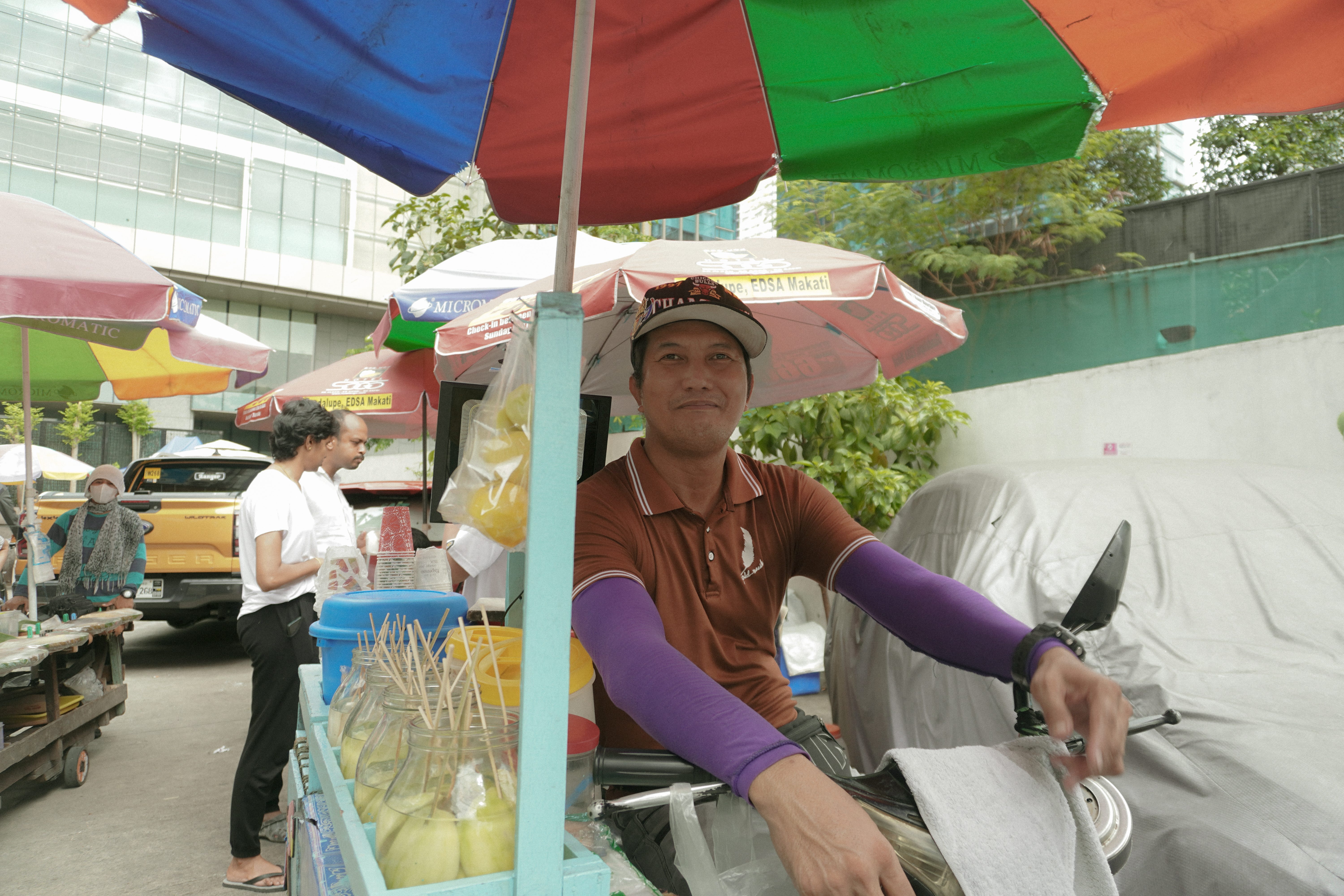
Smiling from his sidecar mango stall, Arnel dela Torre described the bustling Butas area to be not just a mere food hub for, but is rather a vibrant community they have built over time.
“Dito mas makikita mo ‘yong komunidad,” Arnel compares the lifestyle in BGC and in his food stall on the other side of the wall.
(“Here you can see the community”)
Bridging worlds
BGC “Butas,” sometimes referred to as “Lagusan,” are terms coined by locals to describe a passageway or hole that connects the modern and vibrant exterior of Bonifacio Global City to a more humble residential area of Barangay South Cembo.
Through time, this area has gained attention, both online and offline, because of its stark contrast to BGC’s fast-paced environment.
The origin of BGC Butas dates back to the district's major urban development in 1995.
An official from Barangay South Cembo said that during the construction of the district, half of 7th Avenue, which was part of South Cembo and previously owned by Makati, was integrated into the territory of Federal Land, Inc., one of BGC’s developers.
To create a more accessible route for construction workers moving between the two areas, some locals created an actual hole in the fence that BGC put up, thus popularizing the term "BGC Butas."
“Kasi wala talagang daanan ‘yan. So going back years ago, [yung butas] naging access ‘yan during the time na nagsisimulang magkakaroon ng construction… So maraming nagwo-work diyan, [mga] construction worker. Ginawa nilang daanan diyan,” she said.
(Because there really was no path there. So going back years ago, [the hole] became an access during the time when the construction was starting to happen... So there were a lot of people working there, construction workers. They made a way there.)
In 2018, a 66-story Metrobank Center and Grand Hyatt Manila were established in Grand Central Park, a mixed-use complex developed by Federal Land. This development restricted South Cembo's access to the property, prompting concerns from Makati City.
To address this issue, a Deed of Undertaking was established between the Federal Land and Makati City.
Both parties agreed to provide South Cembo with a gated passage to BGC for people to use. However, the catch was that it could only be used for emergencies, such as ambulances, police, and fire trucks, hence its formal name, Emergency Vehicle Access (EVA).
“Kahit anong klaseng emergency, kung private vehicle ‘yan, hindi pwede. So talagang lagi siyang nakasarado… [Then] yung pedestrian access is exclusive for residents of South Cembo only.”
(No matter what kind of emergency, if it’s a private vehicle, it’s not allowed. So it’s really always closed… [Then] the pedestrian access is exclusive for residents of South Cembo only.)
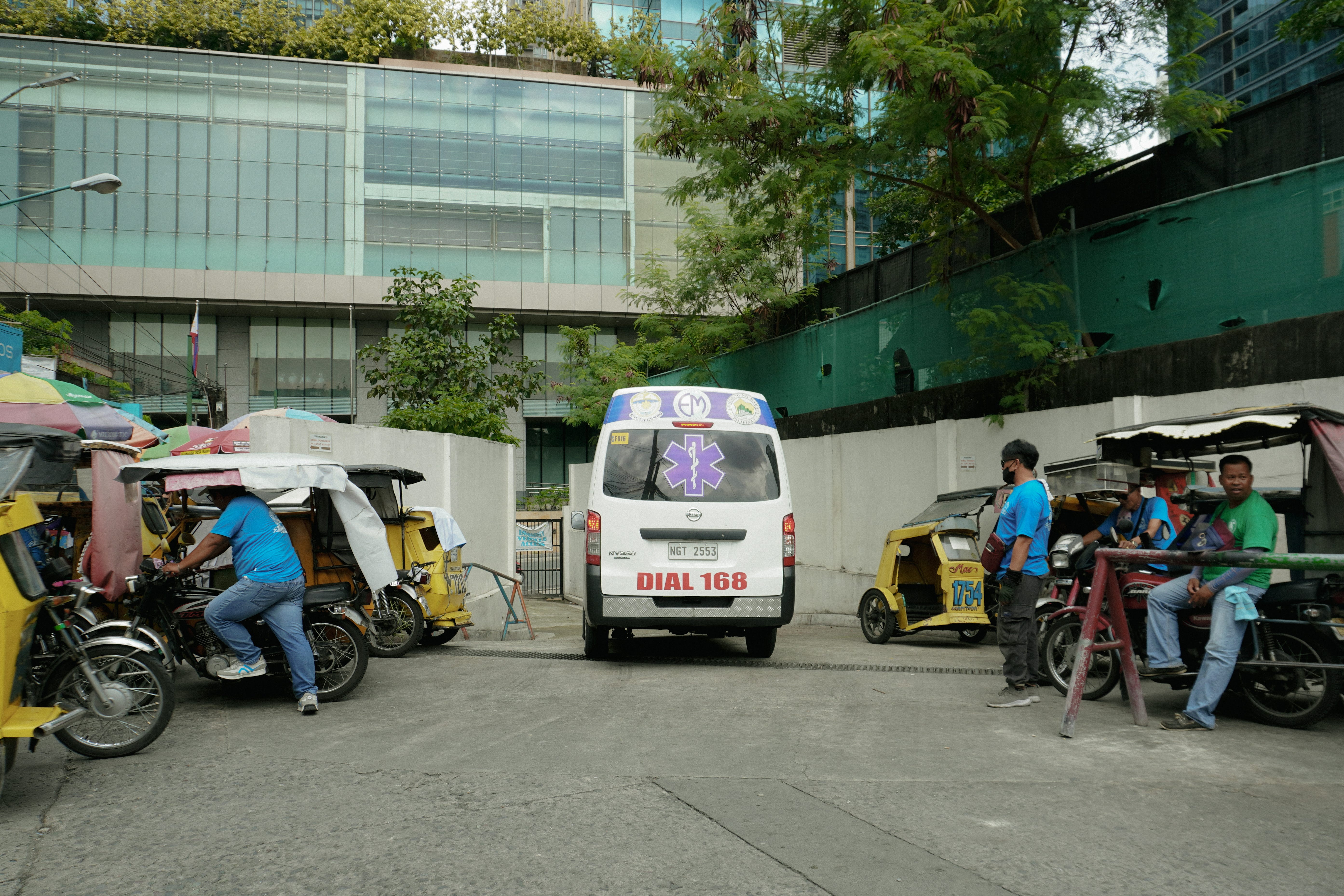
But along with the rise of buildings came an undeniable increase in job opportunities and population. Residents and non-residents of South Cembo began putting up businesses like sari-sari stores, eateries, and street food carts to cater to the numerous employees in BGC.
The influx of people going in and out of the passageway led to the disregard and neglect of EVA restrictions.
While some may view “Butas” as an eyesore because of its apparent disparity to the posh and clean city area, it has become a lifeline for many, especially for locals who are trying to make a living and employees who are trying to make ends meet.
For them, no wall can restrict their right to access a place and seek opportunities.
Contrasts in concrete
Amid the tall skyscrapers that penetrate the skyline like symbols of progress, lies a hidden reality that often goes unnoticed.
Unlike the full-glass buildings in BGC, homes in this area are concrete, forming a contrast in architectural designs.
However, according to the Office of Barangay South Cembo, businessmen are eager to buy properties in their area to initiate development. The problem is the business will not thrive as outsiders are not permitted to enter unless they are “authorized.”
“Syempre, we welcome progress. Pero ‘yong katulad nito, since may boundary kasi, may walls, hindi sila makadaan… Maganda naman ‘yong progress, kaya lang din pinag-aaralan talaga,” they said.
(Of course, we welcome progress. But with something like this, since there are boundaries, there are walls, they can't get through... The progress is good, but it has to be studied as well.)
While it is true that BGC has brought economic opportunities and improved infrastructure to some parts of the city, it has also exacerbated socioeconomic inequalities, contributing to poor urban development and pushing marginalized communities to the outskirts.
Architect and visual artist Isola Tong noticed this contrast while researching green spaces in the Philippines for an art project. She came across a striking image on Google Earth—an aerial view that juxtaposed BGC with its neighboring areas.
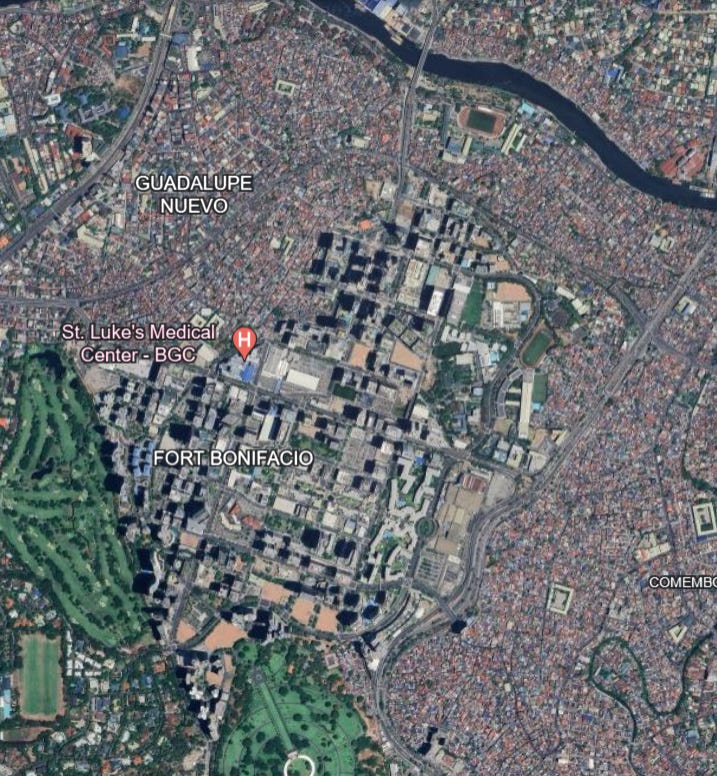
Screen grab from Google Earth 2024
Reflecting on this stark contrast, she pondered, “If the economy is thriving, why do ordinary Filipinos not feel its benefits? Why do our city streets appear so sharply divided from above?”
Inside the gated Butas, vendors sell affordably priced goods three-fold on the streets. Unlike BGC, where "luxury and elegance" seem prioritized, survival comes first here, overshadowing any pursuit of corporate success.
For Dela Torre, he supports development that could bring more people to the area, potentially boosting his mango business. However, this comes at the cost of finding designated spaces where he is "permitted" to sell.
“Papayag kami [sa development], kaya lang hahanap na lang kami ng space namin na hindi bawal. Makakatulong din kami na hindi makasikip…Hindi kami mawawala, pero hindi rin kami makakaistorbo,” he said.
("We support the development, but we will just look for our own space where it's not prohibited. We can also help to avoid overcrowding... We won't disappear, but at least we won't be a disturbance either.")
Meanwhile, Limuel Adan, a messenger who works at BGC, worries that if these affordably-priced food stalls are placed inside BGC, many residents would complain.
“Kapag pumasok ka sa loob niyan, pwede ka sitahin diyan may marshal. Ayaw nung iba na medyo mayaman na makakita ng pakalat-kalat kasi the word aura, dapat elegante lalo’t nasa loob ka ng hotel. So nakakasira in terms of sa guest,” he said.
(When you enter there, you might get stopped by a marshal. The wealthy don't want to see disorderliness because it ruins the ambiance of the place. It should be elegant, especially inside a hotel. So it affects the guests negatively.”)
Walking through both walls, you see the gap between those who have much and those who have little. For some, BGC is a sign of hope—a chance to improve their lives. For others, it shows how unfair life can be.
Maybe that is the goal—to build sustainable districts. But until such time that every Filipino can have better living conditions, systemic inequality will persist. In fact, the government only takes one search, as Tong also noted, to notice and close this social segregation in our society.